Well, the Rangers did get to play October baseball this year, but unfortunately, it wasn’t the kind we were looking for, it was just the final game in a very dismal season.
Ryan Glynn pitched like he was the ace of the staff yesterday. He went toe to toe with Oakland starter Tim Hudson, going a total of 7 innings, and giving up 2 runs on six hits. Two of the runs were in the final inning he pitched, when he seemed to be getting the ball up, Oakland hit two solo home runs. Other than that, he was masterful. Pitch count was good, he walked four, struck out four, and generally pitched awesome.
Problem was that Tim Hudson was even more awesome. With the division crown on the line, and going for his 20th win, Tim Hudson pitched like a CY Young winner. He went 8 innings, giving up no runs, striking out ten, and giving up only four hits. There were two walks, but one of them was intentional. Tim Hudson was totally awesome, and from the looks of yesterday’s game, he was a big part of the success the A’s have had this year.
My hat goes off to the A’s – they are worthy champs, and I hope they go further than we were able to in the last couple of years in the playoffs against the Yankees.
I did notice on the TV coverage that after the A’s had won, you didn’t hear anything from Tom Grieve anymore. I wonder if he was on the field or in the A’s clubhouse to congratulate his son or something. Again, I can’t express how glad I am it was the A’s that won the division, and not the Mariners. I don’t dislike the Mariners, but I like the A’s – great young team, great heart. Also, I’m from Philadelphia, so there’s that tie too (Although when I was born, they had already left for Kansas City).
G161: SWEET MOTHER OF GOD! Rangers lose 23-2!
OH MY GOD! – Just when you didn’t think it could possibly get worse – it does. Worst loss ever in team history, and the most runs the A’s ever score in their team history – going all the way back to the Philadelphia days.
A big two THUMBS DOWN! Could it get any worse on the final game tomorrow? Look at this box score!
Line Score
AL  FINAL
1  2  3   4  5  6   7  8  9     R  H  E
-  -  -   -  -  -   -  -  -     -  -  -
TEXAS               0  1  0   0  0  0   0  0  1     2  9  0
OAKLAND             9  0  1   0  5  0   8  0  x    23 24  0   (FINAL)
BATTERIES:  TEX - DARREN OLIVER, BRIAN SIKORSKI (1ST), MATT
PERISHO (5TH), FRANCISCO CORDERO (5TH),
JONATHAN JOHNSON (7TH), DOUG DAVIS (7TH), JEFF
ZIMMERMAN (8TH) AND RANDY KNORR, BJ WASZGIS
(8TH)
OAK - BARRY ZITO, SCOTT SERVICE (7TH), TODD BELITZ
(9TH) AND RAMON HERNANDEZ, SAL FASANO (6TH)
WP - BARRY ZITO (7-4)
LP - DARREN OLIVER (2-9)
SAVE - NONE
HOME RUNS:  TEX - NONE
OAK - RANDY VELARDE (11) OFF SIKORSKI IN THE 1ST, 1 ON
JASON GIAMBI (43) OFF SIKORSKI IN THE 3RD, 0 ON
MIGUEL TEJADA (30) OFF CORDERO IN THE 5TH, 3 ON
RYAN CHRISTENSON (4) OFF D DAVIS IN THE 7TH, 2 ON
TIME:  3:32     ATT:  35,546
PROBABLES:  TEX - RYAN GLYNN (5-6, 5.84)
OAK - TIM HUDSON (19-6, 4.31)
Box Score
TEXAS (2) VS OAKLAND (23) - FINAL
TEXAS                  ab  r  h rbi bb so lob   avg
Sc Green cf             5  0  1  0   0  1   5  .242
R Clayton ss            3  0  0  0   0  2   0  .241
M Young 2b             2  0  0  0   0  1   3  .000
R Palmeiro 1b           3  0  0  0   0  2   0  .288
Dransfeldt ss          1  0  0  0   0  1   1  .115
Curtis lf               3  0  0  0   0  1   0  .275
a-Valdes ph-rf         1  0  1  0   0  0   0  .260
Sierra dh               4  1  1  0   0  0   2  .237
Ledee rf-lf             2  1  1  0   2  1   0  .238
Sheldon 2b-1b           4  0  2  0   0  1   1  .289
Lamb 3b                 4  0  2  1   0  0   0  .276
Knorr c                 3  0  0  0   0  0   5  .303
Waszgis c              1  0  1  1   0  0   0  .222
Totals                 36  2  9  2   2 10  17
a-singled for Curtis in the 8th.
BATTING: RBI - Lamb (47), Waszgis (4). Runners left in scoring
position, 2 out - Sc Green 2, Knorr 1, Sierra 1, M Young 1.
Team LOB - 9.
OAKLAND                ab  r  h rbi bb so lob   avg
Long cf                 4  3  3  3   1  0   0  .290
b-Porter ph-cf         1  1  0  0   1  0   0  .154
R Velarde 2b            5  3  3  2   0  0   2  .277
Menechino 2b           2  1  2  2   0  0   0  .255
Ja Giambi 1b            3  3  3  3   2  0   0  .334
Je Giambi pr-1b        2  0  1  0   0  1   1  .253
Saenz dh                3  0  1  1   1  0   1  .310
J Ortiz pr-dh          2  2  1  1   0  1   3  .182
d-Hinch ph             1  0  0  0   0  1   2  .250
Tejada ss               4  1  1  5   1  0   4  .275
c-Byrnes ph-rf         1  1  1  0   0  0   0  .300
Grieve lf               4  1  1  0   1  1   2  .279
R Christenson pr-lf    1  2  1  3   0  0   0  .248
Piatt rf-3b             6  2  4  0   0  1   2  .299
Chavez 3b               0  1  0  0   1  0   0  .280
a-M Bellhorn ph-3b-ss  4  0  0  0   1  3   5  .154
Ra Hernandez c          2  1  0  1   1  1   2  .238
Fasano c               3  1  2  2   0  1   0  .214
Totals                 48 23 24 23  10 10  24
a-walked for Chavez in the 2nd; b-walked for Long in the 7th;
c-singled for Tejada in the 7th; d-struck out for J Ortiz in the 8th.
BATTING: 2B - Long (34, Sikorski); Grieve (39, Cordero); Fasano
(6, Cordero); Piatt (5, Jo Johnson); Menechino (9, Jo Johnson).
HR - R Velarde (11, 1st inning off Sikorski 1 on, 2 out); Ja Giambi
(43, 3rd inning off Sikorski 0 on, 2 out); Tejada (30, 5th inning
off Cordero 3 on, 1 out); R Christenson (4, 7th inning off D Davis
2 on, 2 out). RBI - Ja Giambi 3 (137), Saenz (32), Tejada 5 (115),
Ra Hernandez (61), Long 3 (80), R Velarde 2 (40), Fasano 2 (19),
Menechino 2 (26), J Ortiz (1), R Christenson 3 (18). 2-out RBI -
Ra Hernandez, Long 3, R Velarde 2, Ja Giambi, J Ortiz,
R Christenson 3. Runners left in scoring position, 2 out -
Ra Hernandez 1, M Bellhorn 1, Tejada 2, Hinch 1.  Team LOB - 11.
--------------------------------------------------
Texas          - 010 000 001  --  2
Oakland        - 901 050 80X  -- 23
--------------------------------------------------
TEXAS                        ip       h   r  er  bb  so  hr    era
D Oliver (L, 2-9)               2/3   5   6   6   1   0   0   7.50
Sikorski                      3 1/3   4   4   4   4   2   2   5.73
Perisho                         1/3   3   4   4   1   1   0   7.46
Cordero                       1 2/3   3   1   1   2   2   1   5.35
Jo Johnson                      2/3   5   7   7   2   2   0   6.21
D Davis                         1/3   2   1   1   0   1   1   5.38
Je Zimmerman                  1       2   0   0   0   2   0   5.30
OAKLAND                      ip       h   r  er  bb  so  hr    era
Zito (W, 7-4)                 6       5   1   1   1   7   0   2.72
Service                       2       2   0   0   0   2   0   6.38
T Belitz                      1       2   1   1   1   1   0   2.70
WP - Perisho.  Pitches-strikes: Zito 100-62; Service 34-22; T
Belitz 16-10; D Oliver 29-18; Sikorski 73-38; Perisho 29-19;
Cordero 39-21; Jo Johnson 37-20; D Davis 20-13; Je Zimmerman
28-21.  Ground balls-fly balls: Zito 6-5; Service 2-2; T Belitz
1-1; D Oliver 2-0; Sikorski 1-7; Perisho 0-0; Cordero 0-3; Jo
Johnson 0-0; D Davis 0-0; Je Zimmerman 0-1.  Batters faced: Zito
24; Service 8; T Belitz 6; D Oliver 8; Sikorski 18; Perisho 5;
Cordero 10; Jo Johnson 9; D Davis 3; Je Zimmerman 5.
UMPIRES: HP--John Shulock. 1B--Brian Runge. 2B--Rocky Roe.
3B--Ian Lamplugh.
T--3:32.  Att--35,546.   Weather: 72 degrees, sunny.   Wind: 7 mph,
out to right.
Dick Bosman Fired
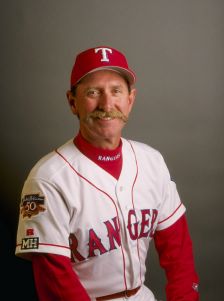 TEXAS RANGERS WILL NOT RETAIN DICK BOSMAN AS PITCHING COACH FOR 2001 SEASON
FOR RELEASE: Immediate
The Texas Rangers announced this morning that Dick Bosman will not return as the team’s major league pitching coach for the 2001 season.
Bosman, who has served as the Rangers’ pitching coach for the last six years, also will not work the final three games of the season this weekend in Oakland. Bullpen coach Larry Hardy will handle the pitching coach duties for the Oakland series. The search for a new pitching coach will begin after the season.
“The decision to change pitching coaches was totally mine,†commented Rangers Manager Johnny Oates. “After further analyzing where we are and where we want to be, I felt it was time for an overall change in our pitching philosophy.
“Dick and I have worked together for a long time, and I appreciate all his efforts. The job of a pitching coach in today’s game is a tough one. He is not the reason that we have failed to perform up to expectations this season. However, I feel that we need to make improvement and progress in our overall pitching.â€
Bosman served as Oates’ pitching coach in Baltimore from 1992-94 before joining him in Texas for the 1995 season. The former major league pitcher with Washington/Texas, Cleveland, and Oakland from 1967-76 was previously pitching coach for the Chicago White Sox in 1986-87 and a minor league pitching instructor for Baltimore from 1988-91.
Oates also indicated that the other five members of the major league coaching staff: dugout coach Bucky Dent, bullpen coach Larry Hardy, hitting coach Rudy Jaramillo, first base coach Bobby Jones, and third base coach Jerry Narron have been invited to return for the 2001 season. Dent, Hardy, Jaramillo, and Narron have been on Oates’ staff since 1995. Jones was added in May, 2000 following the retirement of Ed Napoleon.
Roster Transaction
- Pitching Coach Dick Bosman not asked to return
for next season – will not work the remainder of the season.
G160: Rangers drop opener to A’s, 7-5, Dick Bosman fired
The final series of the season. I hope going into this series that we actually lose all three, and let the A’s win it. We have nothing to play for at this point – the season is just about a total loss, we’re way in last place, and the only point in winning now would be to help the Mariners. Given a choice between the Mariners and the A’s, I’d rather the A’s get the division crown.
Well, we followed up on this plan in Game 1, losing 7-5. As losses go, it wasn’t the worst, we didn’t lie down, but a loss is a loss, and in this season, there’s a ton of ’em. 89 losses. That means we have to win both the last two to avoid a 90 loss season – don’t think it’s gonna happen. :)
We used seven pitchers, Kenny Rogers going 4.1, giving up five hits, and 3 earned runs. No one else pitched more than a single inning (Perisho had a 0 for IP). Francisco Cordero gave up two runs in 2/3 of an inning, and Jonathan Johnson & Mike Venafro each gave up a run, but neither was earned. On our side of the stick, we had a few decent nights by Scott sheldon, who went 2 for 3 after coming in early for Luis Alicea (Luis never played the field), Royce Clayton, who went 3 for 5, and Randy Knorr, who went 3 for 4.
Johnny Oates also fired Dick Bosman, which was a surprise, as they’d been together 9 years over two teams. Be curious to see who we bring in as a pitching coach. My initial vote – Bill Haselman.
G159: Rangers win with big offense, 13-6
Well, I was really hoping to come out of Seattle winning two of three and hurting Seattle – I really want to see the A’s win the division. Didn’t happen. No change in the standings at all during this series – Seattle is still 1/2 game up on Oakland going into the final three games of the season.
I had forgotten this game was on at 5:30, and didn’t see much of it, as I tuned in late. I did get to see Ruben Sierra’s home run – I was really really hoping he’d get one, on the (fairly decent) chance he won’t be here next season. He was all kinds of smiles in the dugout, and that was very nice to see – my wife even commented that it’s great to see players smile like that.
The other notable about this game (other than the fact we trounced on the Mariners) was the 5 stolen bases by Scarborough Green. I really think he should be given a shot at a 5th outfielder position. It’s too bad he can’t hit – because he plays passable defense, and has some ungodly speed – he could be a great leadoff hitter.
This weekend Tom Grieve has a chance to see his son’s team clinch the division with him announcing it. That must be cool for him.
G158: Rangers lose to Mariners, 6-4
As this season draws to a close, I’m finding it harder and harder to sit and watch an entire game without flipping channels, looking at something else on my TiVo… This game was no exception.
We lost, and we had chances. We couldn’t follow through and beat the Mariners’ closer for the win. Oh well.
Roster Transaction
- Recalled IF Mike Young from AA Tulsa.
G157: Rangers shut out by Sele and M’s, 5-0
Not much to talk about here. We lost 5-0 on a complete game shutout by our traitor old friend, Aaron Sele. He pitched a 6 hit complete game shutout. We couldn’t get anything going at all. Period.
About the only highlights on the other side was a pickoff of Rickey Henderson by Ryan Glynn early in the game, and the fact that our bullpen didn’t make the game any worse. :)
Worst Trades in Team History: 3rd Worst
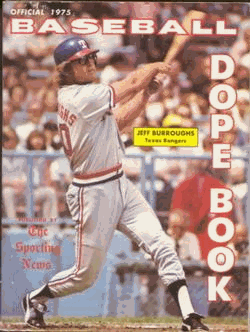 On December 9th, 1976, the Rangers traded Jeff Burroughs (OF) to the Atlanta Braves for Roger Moret (P), Carl Morton (P), Adrian Devine (P), Ken Henderson (OF) and Dave May (OF). If you thought that the Rangers received little in return for the Righetti trade, they traded away one of their first stars for literally nothing in return.
Burroughs came to the Rangers with the Senators and was the nation’s first draft pick in 1969. He first came up with the Senators at age 19, and often clashed with manager Ted Williams, though Burroughs later credited Williams for teaching him to concentrate. In 1973, in his first season as the Rangers starting right fielder, Burroughs hit 30 homers and was immediately thought of as one of the premier young power hitters in the game. Burroughs followed that up by hitting .301 with 25 homers and a league-leading 118 RBI in 1974, he also won AL MVP that year. Burroughs often complained about the south wind at Arlington Stadium and he continued to strike out at a torrid pace. The Rangers felt that they could spare him. In his first year after the trade, Burroughs hit 41 homers with 114 RBI with the Braves.
Roger Moret was the “big-gun” in this trade and he played for the Rangers for 1 ½ years, going 3-4 in 25 games. The sidearming Moret’s aim for the strike zone was erratic as his personality, but when he had control of both he was a capable winner. Moret was coming off of a 14-3 season at the time of the trade, and the Rangers were looking to see more of that.
Carl Morton won the NL rookie of the Year award in 1970 for the Expos, he was never quite the same again. In fact, at the time of the trade, Morton was pitching in the minors. I don’t know if the Rangers were thinking that he would return to his form from 6 years earlier, but if they were, it was quite a stretch. Morton never played in the Majors again and died at age 39 of a heart attack after jogging.
Adrian Devine was actually a nice surprise out of this deal. He came off arm surgery in 1975 and rebounded to go 11-6 with a 3.58 ERA and 15 saves in 1977. Devine then returned to Atlanta in 1978, was then traded back to Texas in 1979 in a very complicated deal. Arm troubles were his demise in 1980.
The Rangers were looking at getting a superstar out of Ken Henderson when they made this deal. Ken was touted as Willie Mays successor when Henderson was only 19. Henderson only played in 75 games in 1977 and was then traded to Cincinnati. In those 75 games, he hit only 5 HR and 23 RBI.
Dave May also managed to stay with the Rangers for the entire 1977 season. Not that this was a good thing, May hit .241 with 7 HR and 42 RBI. May had showed some promise earlier in his career. In 1973, he hit 25 HR, 93 RBI and a .303 average. In a part-time role with the Braves in 1975, he hit 12 HR in only 203 AB”s. He dropped off again in 1976, thus prompting the Braves to trade him.
This trade boils down to one thing, the Rangers took players that they were either hoping would develop, or return to form from a few seasons back. They traded one of the best, young power hitters in the game for these guys, and not one of them panned out. Now, if Ken Henderson went on to star for the Rangers for 10 years, would I be writing this article? No way, but the fact is, the franchise took five separate chances when they made this deal, and not one of them worked out.
Remember the Rangers!
Jeremy Northrip
rangerhistory@hotmail.com
- « Previous Page
- 1
- …
- 453
- 454
- 455
- 456
- 457
- …
- 521
- Next Page »